KYC verifies who opened the account. It doesn't verify who's in it now.
Know Your Customer compliance has always been about the moment of onboarding. The threat has moved to what happens in every session after that.



The problem
KYC was designed to establish identity at the point of relationship. It does that job well. What it was never designed to do is maintain continuous identity assurance throughout the customer lifecycle — across every login, every transaction, every session. The fastest-growing fraud vectors in KYC-regulated environments don't defeat the onboarding check. They circumvent it entirely by operating inside sessions that were opened legitimately. Stolen session credentials, account sharing, and AI-generated synthetic identities all exploit the gap between a verified account and an unverified session. Your KYC process confirmed who opened the account. It cannot confirm who is operating it today.
The Onboarding Gap
KYC confirms who opened the account. It was never designed to verify who is operating it — across every login, transaction, and session that follows.
Session Exploitation
Stolen credentials, account sharing, and session hijacking all operate inside accounts that passed onboarding checks. The fraud enters after identity is established, not before.
AI-Synthetic Identities
Generative AI enables synthetic identity creation that defeats point-in-time verification. The gap between a verified account and an unverified session is widening.
How YEO serves KYC-regulated industries
Extend KYC Beyond Onboarding
Continuous session verification that runs alongside your existing KYC stack, closing the gap between account creation and ongoing session assurance.
Transforms point-in-time KYC into a continuous trust model that meets the direction AML frameworks are already moving in.
Defeat Session-Layer Fraud
Real-time presence verification at the point of transaction — stopping the attack vector that doesn't defeat KYC; it operates around it.
Three verification layers: Advanced Facial Mapping, Anti-Spoofing Liveness Detection, and Depth Verification.
No New Compliance Exposure
All biometric processing happens on the user's device. No biometric data is transmitted or stored externally.
No new data risk in an already regulated environment.
On-device architecture is a structural fact, not a policy promise.
Relevant Solutions
The continuous addition to your KYC stack
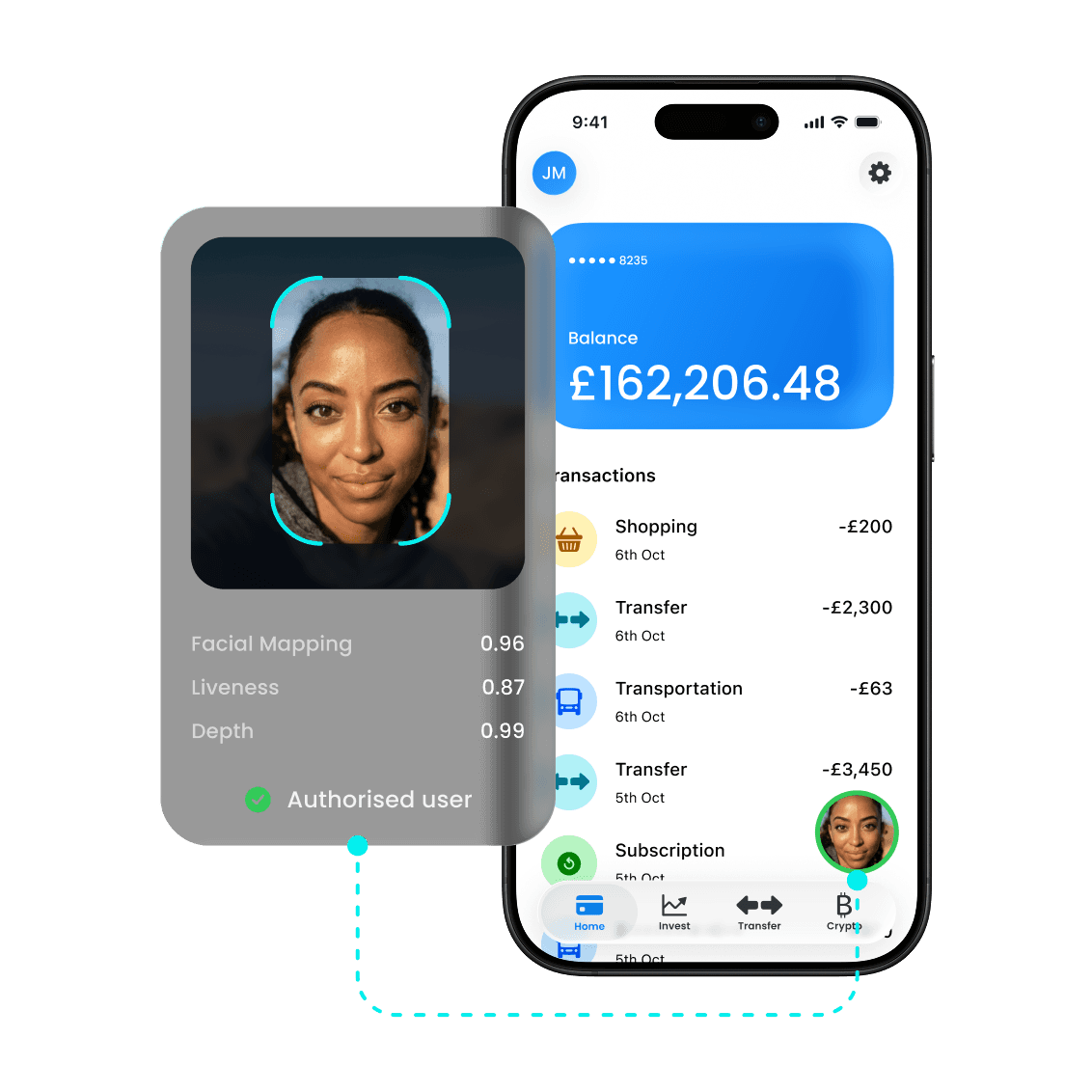
YEO CFR SDK
The YEO CFR SDK extends your existing KYC process beyond onboarding — running continuous, passive identity verification throughout the customer session to close the gap that account takeover and session hijacking exploit.