Insights
|
Share
Why YEO Isn’t Just Another Messaging App: Comparing YEO to Signal, WhatsApp, and Telegram

With so many messaging apps claiming to be “private” or “secure,” it’s easy to assume they’re all doing the same thing: encryption, some access control, and maybe a disappearing message feature or two.
But if you’re a business, organisation, or professional dealing with sensitive information, the truth is this:
Most messaging apps weren’t built for what you need.
They’re built for convenience. Not compliance.
Privacy-ish. Not privacy-first.
Access control? Minimal. Identity verification? Non-existent.
This is where YEO Messaging sets itself apart.
Let’s break down how YEO compares to three of the biggest names in “secure messaging”: WhatsApp, Signal, and Telegram, and why it may be the only option built to meet today’s digital trust demands.
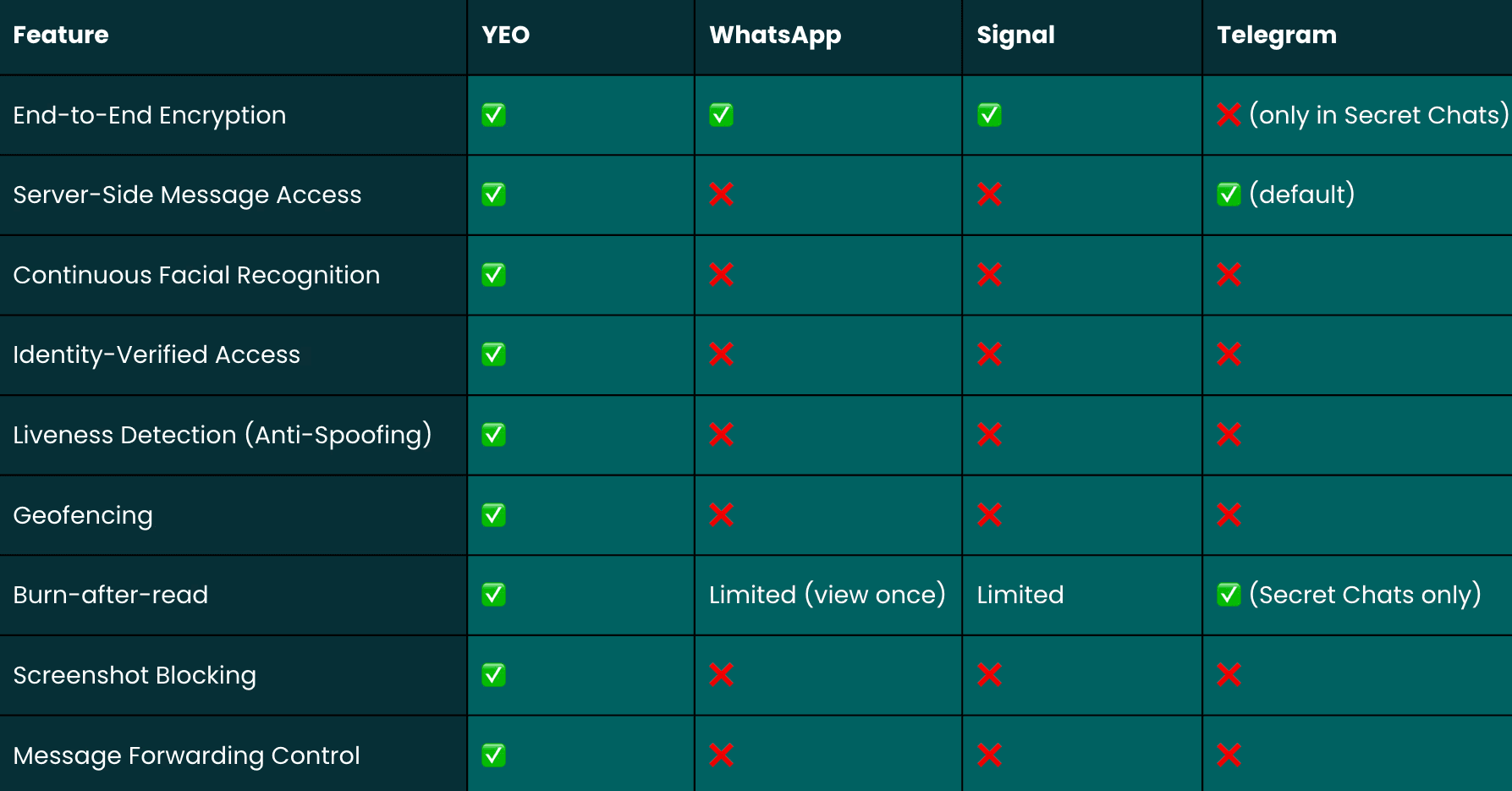
End-to-End Encryption — Standard, But Not Enough
Most secure messaging apps today use end-to-end encryption, which is great! But this is now table stakes. What’s missing is what happens after the message reaches the device.
YEO goes beyond encryption — building security into identity, visibility, and context.
Identity Verification: This Is Where YEO Changes the Game
With YEO Mode, messages are only visible while your verified face is in front of the screen.
No screenshots. No snooping. No shared access.
Other apps assume that if you’ve unlocked your phone, you’re the one using it.
YEO proves it continuously.
This makes it ideal for:
Executives handling sensitive deals
Legal, healthcare, or finance professionals
Teams working in high-compliance environments
Crisis comms and out-of-band communication
Contextual Controls: Security With Boundaries
YEO empowers senders to control where, when, and how long a message can be viewed, making it radically different from anything else on the market.
Messages can be restricted to:
A geographic location (e.g. office, country)
A verified identity
A short, specific window of time
It’s compliance-ready, without the complexity.
Built for Enterprise, Not Just Chatting
While WhatsApp, Signal, and Telegram are fantastic for personal use, they weren’t designed for:
Regulated industries
Incident response teams
Secure internal communications
Audit trails or access control
YEO, on the other hand, was built with enterprise needs in mind — from SDK and API integrations, to enterprise-grade identity verification, to no-message storage architecture.
No metadata harvesting.
No third-party access.
No messages stored anywhere, they shouldn’t be.
YEO Is Messaging — Reinvented
If you’re choosing a messaging app for day-to-day chats with friends, any of these platforms might work.
But if you’re handling:
Sensitive, regulated, or high-risk communications
Executive-level decision-making
Confidential deals or client data
Anything that could be used, leaked, or manipulated out of context
Then YEO isn’t just another messaging app — it’s the one built for you.
Ready to try? Book a demo
Share


About us
We stopped asking "who logged in." We started asking "who's still there." YEO began as a secure messaging app. Today we build the patented continuous identity verification infrastructure that regulated industries trust to prove who's really there.