Insight
|
Share
Why Out-of-Band Communication Is the Legal Sector's Most Urgent Security Gap
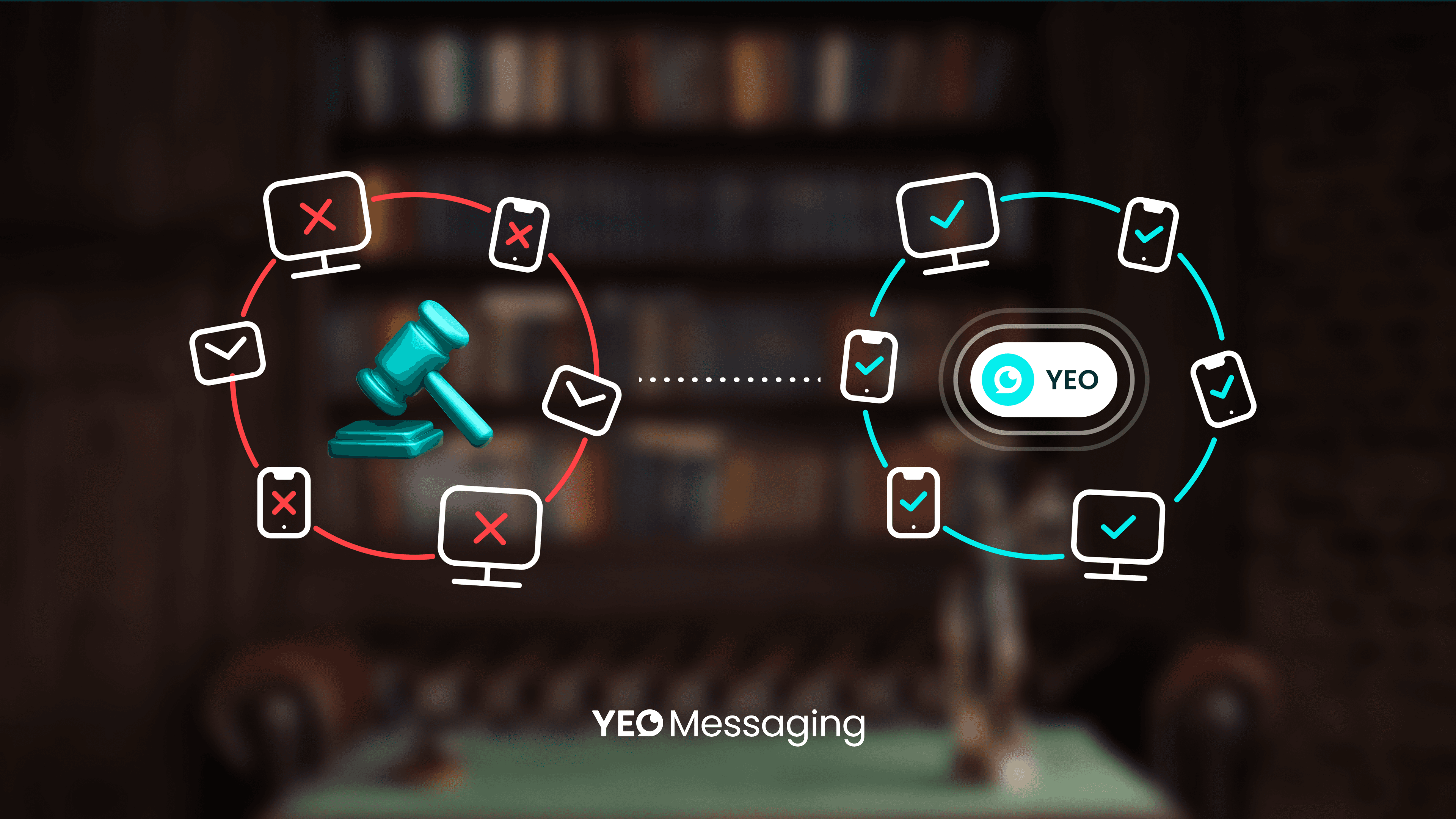
The legal sector handles some of the most sensitive information in existence. Mergers and acquisitions in progress. Criminal defence strategies. Whistleblower identities. Privileged advice that, if intercepted, could alter the outcome of a case, a transaction, or a life.
And yet when a partner needs to brief a client urgently, or a solicitor needs to share a document with counsel at short notice, the tool they reach for is often WhatsApp. Or a personal email account. Or a consumer-grade messaging platform that logs metadata, routes data through international servers, and provides no meaningful identity assurance whatsoever.
This is not a technology failure. It is a risk failure and one that the Solicitors Regulation Authority, the Information Commissioner's Office, and increasingly sophisticated threat actors are all paying close attention to.
The answer is out-of-band communication: a dedicated, isolated channel that operates independently of your primary systems, with continuously verified identities at every interaction.
What Out-of-Band Communication Means for Law Firms
Out-of-band (OOB) communication is a secondary communication channel that runs in parallel with and is completely independent of your primary operational infrastructure. In cybersecurity, it is most commonly associated with incident response: when your systems are compromised, how do you coordinate a response without using the channels that may already be monitored by the attacker?
But for law firms, the application is far broader and more immediate. Every conversation between a fee earner and a client, every message between counsel and instructing solicitors, every discussion of case strategy or deal terms is a potential point of exposure. If those conversations are happening on uncontrolled channels, with no verified identity assurance and no data sovereignty, the risk is not theoretical; it is constant.
The principle is straightforward: sensitive legal communications should happen on a channel that is controlled, verified, and isolated from your general infrastructure. A channel where you know who is speaking, where the data does not persist, and where there is no route for that information to leave the controlled environment.
The Regulatory Reality Law Firms Cannot Ignore
The SRA's approach to data security and technology risk has sharpened considerably in recent years. The SRA Code of Conduct requires solicitors to keep client information confidential, not just in principle, but in practice, across every channel through which that information flows.
The ICO's enforcement record in the legal sector tells its own story. Law firms have faced significant fines and reputational damage following data incidents that originated not from sophisticated external attacks, but from basic failures in communication hygiene, emails sent to the wrong recipient, messages forwarded outside controlled environments, and client data shared via consumer platforms with no accountability trail.
GDPR obligations apply to every piece of personal data a law firm handles. The lawful basis for processing, the principle of data minimisation, and the requirement to demonstrate appropriate technical and organisational measures all extend to the communication tools a firm uses. Using a consumer messaging application to discuss client matters is not just a reputational risk — it is a compliance failure waiting to be documented.
For firms handling particularly sensitive matters — criminal defence, family law, employment disputes, corporate transactions—the stakes are compounded by legal professional privilege. Privilege depends on confidentiality. Once a privileged communication passes through an uncontrolled channel, the basis for maintaining that privilege is weakened. This is not a hypothetical concern. It is a risk that courts and regulators are increasingly willing to examine.
The Identity Problem That Secure Messaging Alone Cannot Solve
The instinct of most law firms, when confronted with communication security concerns, is to switch to an encrypted messaging tool. Encryption is necessary. It is not sufficient.
Encryption protects the message in transit. It does not protect against the device being accessed by an unauthorised individual. It does not protect against coercion. It does not protect against the account being compromised after the initial login check has passed.
In the legal context, this matters acutely. A solicitor's device, accessed by a third party, a family member, or following theft, can expose client communications, privileged documents, and case strategy even if the messages themselves are encrypted. The session was authenticated once, at the beginning. Everything that followed was assumed to be legitimate.
Continuous identity verification solves this. Rather than authenticating once at login, the platform re-verifies identity throughout the session, using facial recognition, liveness detection, and behavioural signals to confirm that the right person is present at every point in the conversation. If identity cannot be confirmed, the session is terminated immediately.
For a law firm, this means that even if a device is lost, stolen, or accessed without permission, the communication channel remains protected. The session does not outlast the authorised individual's verified presence.
What Secure Legal Communication Infrastructure Needs to Deliver
The gap between consumer messaging apps and genuine out-of-band communication infrastructure is significant. A platform built for the legal sector must deliver:
Continuous identity assurance. Authentication should not end at login. Every session, every file transfer, every message should be backed by a continuously verified identity, not an assumption made hours earlier.
Legal professional privilege protection. Communications must remain within a controlled environment. No third-party server storage, no platform provider data access, no metadata logging that could undermine privilege claims.
Zero server storage. Messages should not persist on infrastructure outside the firm's control. Zero-knowledge architecture ensures that even if external systems are compromised, there is nothing to exfiltrate.
No forwarding, no screenshots. The most common source of legal data leakage is not sophisticated hacking; it is information leaving the controlled environment via forwarding or screenshotting. A platform that structurally prevents this closes the most common vector entirely.
Burn-after-read controls. Sensitive communications should have a defined lifespan. Advice shared in a time-sensitive context should not sit in an inbox indefinitely, available to anyone who accesses the device weeks or months later.
Full audit capability without content retention. Regulators and courts may require evidence of who communicated, when, and with what level of identity assurance, without necessarily requiring the content of privileged communications. A properly designed OOB platform can provide this.
Why This Is Particularly Acute for Law Firms
Law firms occupy a uniquely high-value position for threat actors. The information they hold, M&A timelines, litigation strategy, regulatory investigations, and individual client vulnerabilities is extraordinarily sensitive and commercially significant. Nation-state actors, organised crime groups, and corporate espionage operations have all targeted law firms precisely because the data concentration and communication volume make them high-yield targets.
At the same time, the professional obligation of confidentiality means that a law firm cannot simply point to an industry-wide problem when a breach occurs. The duty to the client is personal and professional. The reputational consequences of a communication security failure in a law firm are not just financial; they are existential.
The distributed nature of modern legal practice compounds this. Remote working, multiple office locations, international client relationships, and reliance on barristers and external counsel all create a communication perimeter that is extraordinarily difficult to secure with traditional tools.
Out-of-band communication is not an add-on or a compliance exercise. It is the missing layer in the legal sector's security architecture, the one that ensures every sensitive conversation is happening between verified parties, in a controlled environment, with no residual data footprint that could surface in a breach, a regulatory investigation, or a privilege challenge.
The Cost of Getting This Wrong
A data incident in a law firm is rarely just a technology problem. It is a matter of professional conduct. Under the SRA's Principles, a failure to maintain client confidentiality can result in regulatory action, fines, and in serious cases, the suspension or revocation of a firm's authorisation to practise.
The ICO has made clear that data protection obligations apply fully to professional services firms. A breach involving client personal data will be assessed not just on technical grounds but on whether the firm had appropriate measures in place, including the communication tools used to handle sensitive information.
Beyond regulatory consequences, the reputational impact of a communication security failure in the legal sector is severe and lasting. Clients instruct law firms on the basis of trust and confidentiality. A breach of either, however it occurs, fundamentally undermines the relationship on which the practice is built.
Conclusion: Confidentiality Is Not a Policy… It Is Infrastructure
The law firms that will lead in the next decade are those that treat confidentiality as an infrastructure requirement, not just a professional commitment. Out-of-band communication is one of the highest-leverage investments a firm can make in this direction, protecting the channel, verifying the identity, and creating the accountability trail that regulators, clients, and courts increasingly expect.
YEO Messaging is built for exactly this environment. Continuous identity verification, zero server storage, and communication controls designed for regulated professional services, giving law firms the infrastructure to communicate with the confidentiality their clients are entitled to expect.
To learn more about our Out-Of-band solution, get in touch.
Share



About us
We stopped asking "who logged in." We started asking "who's still there." YEO began as a secure messaging app. Today we build the patented continuous identity verification infrastructure that regulated industries trust to prove who's really there.