Insights
|
Share
Why Out-of-Band Communication Is InsurTech's Most Overlooked Security Risk
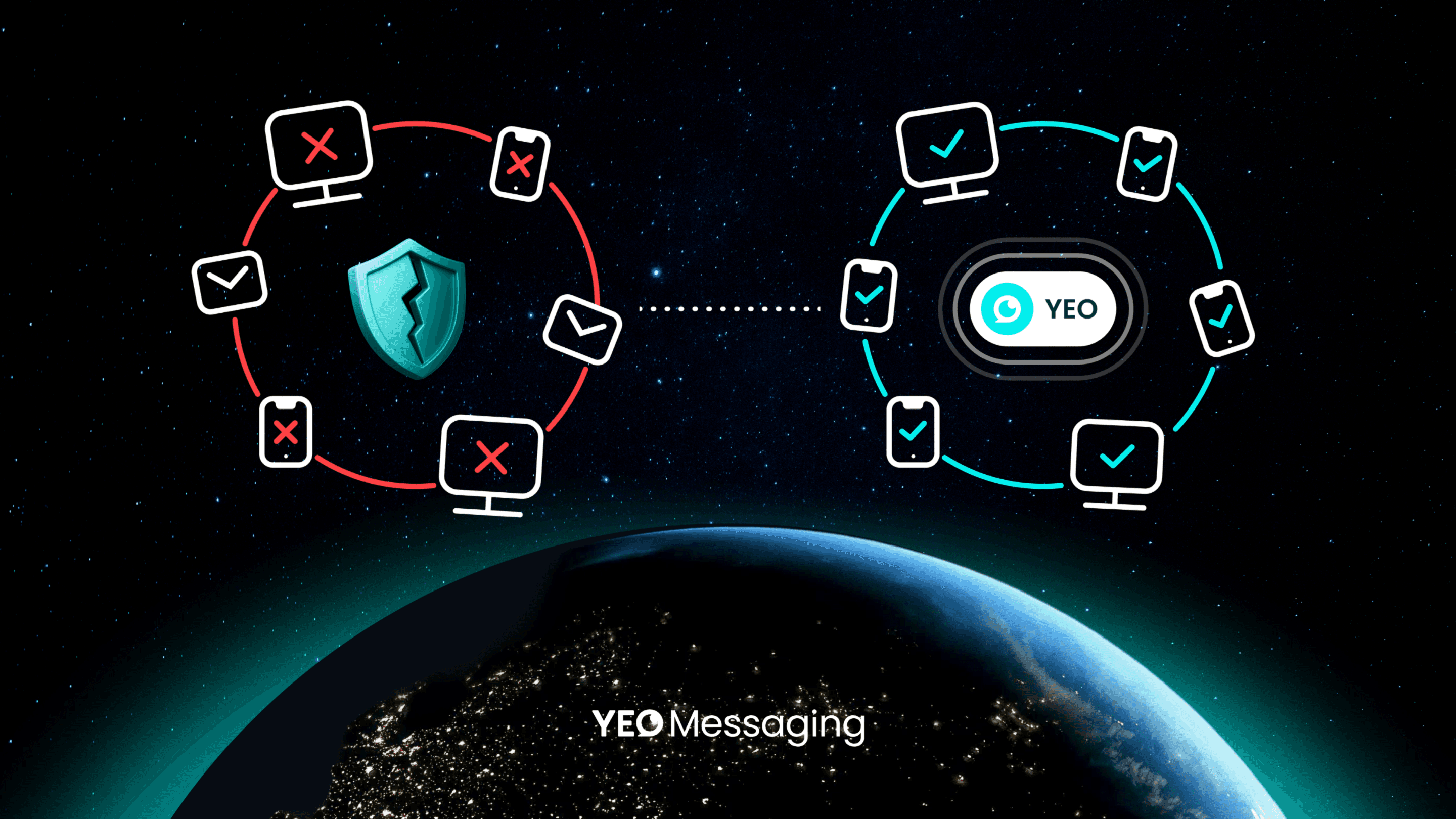
The InsurTech sector has transformed how insurance products are built, distributed, and managed. Digital-first platforms, real-time underwriting, API-driven ecosystems; the pace of innovation is remarkable. But there is one area where InsurTech firms consistently underinvest: the security and integrity of internal communication.
When a claims handler shares sensitive policyholder data over WhatsApp. When an underwriting team discusses risk decisions through a consumer messaging app. When a broker relays a client's medical history in a platform that logs, stores, and potentially trains on that data. These are not hypothetical scenarios; they are daily occurrences across the industry. And they represent a category of risk that no amount of endpoint protection or firewall configuration can address.
That category is insecure in-band communication. And the solution is out-of-band communication — a dedicated, isolated communication channel that operates independently of your primary systems, with verified identities at every interaction.
What Is Out-of-Band Communication — and Why Does It Matter for InsurTech?
Out-of-band (OOB) communication refers to a secondary communication channel that runs parallel to, and independently from, your main operational systems. In cybersecurity, it is most commonly associated with incident response: when your primary infrastructure is compromised, how do you communicate securely without using the very channels that may already be breached?
But for InsurTech businesses operating under FCA oversight, handling highly sensitive personal and financial data, and subject to SMCR accountability requirements, out-of-band communication has a broader and more pressing application: ensuring that every sensitive conversation happens in a verified, controlled, and compliant environment.
The problem is not just external threat actors. Insider risk, whether through negligence, compromised credentials, or malicious intent, is consistently ranked among the top causes of data incidents in financial services. And the most common vector? Communication tools that were never designed for regulated environments.
The Regulatory Pressure Is Building
InsurTech firms are not operating in a regulatory vacuum. The FCA's expectations around data protection, client confidentiality, and Senior Managers and Certification Regime (SMCR) accountability are increasingly extending into the tools and processes firms use to communicate internally and with clients.
GDPR and the UK Data Protection Act 2018 both impose strict obligations on how personal data is handled, stored, and transmitted. Using consumer messaging apps — where data may be stored on third-party servers, routed through international infrastructure, or accessed by the platform provider — creates exposure that most compliance teams have simply not quantified.
The question regulators and insurers will increasingly ask is not just "what security controls do you have?" but "can you prove that sensitive communications were handled by verified individuals, in a controlled environment, with a full audit trail?"
Most firms today cannot answer that question confidently.
The Identity Problem at the Heart of Secure Communication
Out-of-band communication is only as secure as the identity verification underpinning it. This is where most secure messaging solutions fall short. They encrypt the message in transit. They may store nothing on a server. But they do not continuously verify that the person holding the device is who they claim to be.
In insurance, this matters enormously. A single compromised device — a claims manager whose phone is accessed by an unauthorised individual — can expose policyholder data, privileged underwriting information, or client financial records. Encryption alone does not prevent this. Identity assurance does.
This is the principle behind continuous identity verification: rather than authenticating a user once at login, the platform re-verifies identity throughout the session. Facial authentication, liveness detection, and behavioural signals confirm that the right person is present at every point in the conversation. If identity cannot be confirmed, the session is terminated.
For InsurTech firms managing sensitive data at scale, this is not a luxury — it is a foundational control.
What a Purpose-Built Out-of-Band Communication Platform Looks Like
The gap between consumer messaging apps and genuine out-of-band communication infrastructure is significant. Here is what a platform designed for regulated financial services environments needs to deliver:
Continuous identity assurance. Authentication should not end at login. Every session, every message, every file transfer should be backed by a verified identity.
No server storage. Messages should not persist on third-party servers. Zero-knowledge architecture ensures that even if the infrastructure is compromised, there is nothing to exfiltrate.
Burn-after-read and message lifecycle controls. Sensitive information should have a defined lifespan. Once read, once acted upon, it should be gone — not sitting in an inbox waiting to be breached.
No forwarding, no screenshots. The most common cause of data leakage from messaging platforms is not hacking — it is forwarding. A platform that structurally prevents data from leaving the controlled environment closes this vector entirely.
Full audit capability. Compliance requires that you demonstrate what was communicated, by whom, and when. Not the content of messages — but the verified identity of participants and the integrity of the channel.
Why This Is Particularly Acute for InsurTech
InsurTech businesses occupy a uniquely sensitive position. They handle health, financial, and personal data simultaneously — often at high volume and speed. The digital-first nature of the sector means that communication happens across distributed teams, remote brokers, and third-party partners. And the pace of growth often means that security infrastructure lags behind operational expansion.
The result is a communication layer that is simultaneously high-stakes and under-protected.
Out-of-band communication is not an add-on or a compliance checkbox. It is the missing layer in the InsurTech security stack — the one that ensures every sensitive conversation is happening between verified parties, in a controlled environment, with no residual data footprint.
The Cost of Getting This Wrong
The consequences of insecure communication in InsurTech are not abstract. A data incident involving policyholder information can result in ICO enforcement action, FCA intervention, and significant reputational damage. Under SMCR, senior managers may face personal accountability for failures in this area.
The cost of a breach is not just remediation. It is client trust. It is a regulatory relationship. It is the credibility of a business that earns customers' trust in it with their most sensitive information.
Conclusion: Building Secure by Default
The InsurTech firms that will lead the next decade are those building security into their infrastructure by default — not bolting it on after the fact. Out-of-band communication is one of the highest-leverage investments a firm can make in this direction: it protects the channel, verifies the identity, and creates the audit trail that regulators and clients increasingly expect.
YEO Messaging is built for exactly this environment. Continuous identity verification, zero server storage, and communication controls designed for regulated industries — giving InsurTech firms the infrastructure to communicate securely, compliantly, and with confidence.
Want to find out more? Get in touch
Share


About us
We stopped asking "who logged in." We started asking "who's still there." YEO began as a secure messaging app. Today we build the patented continuous identity verification infrastructure that regulated industries trust to prove who's really there.