Insight
|
Share
The Central Bank of the UAE Has Banned WhatsApp for Financial Services. Here's What That Means.
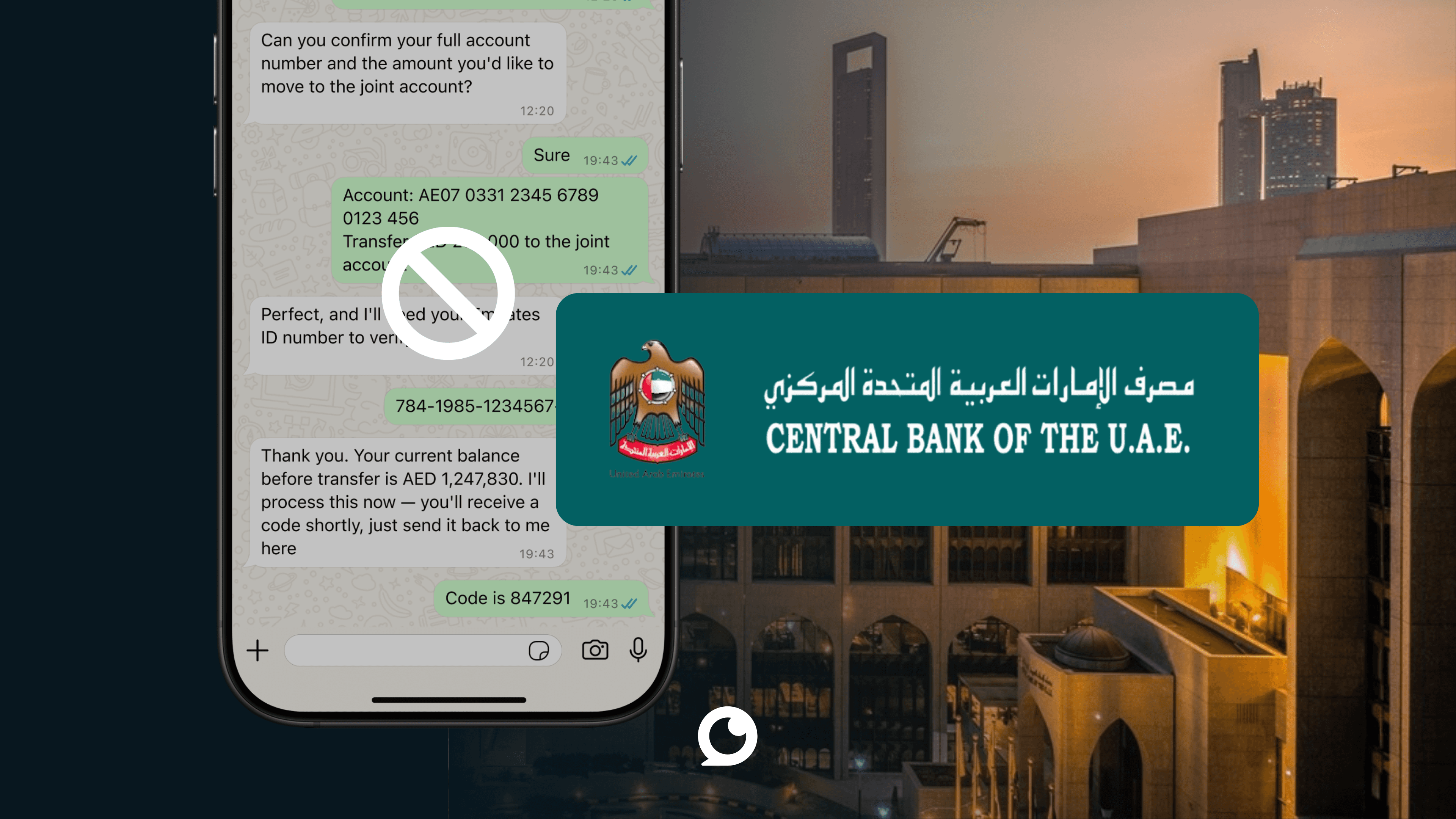
On 17 April 2026, the Central Bank of the UAE issued Notice No. CBUAE/MCS/2026/2058, a formal directive to all licensed financial institutions in the UAE ordering the immediate discontinuation of instant messaging applications as a channel for delivering financial services or sharing customer data.
The compliance deadline is 30 April 2026.
This is not a guideline. It is not a recommendation. It is a binding directive, signed by the Assistant Governor for Banking and Insurance Supervision, with explicit warnings that non-compliance may result in supervisory action, administrative action, and financial sanctions.
For every bank, insurance company, payment provider, and licensed financial institution operating in the UAE, the question is no longer whether to change. It is what to change to — and how fast.
What the Notice Actually Says
The CBUAE's notice is precise in its scope. It defines instant messaging applications as "platforms primarily designed for real-time chat and exchange of content by text, voice, video or files", which means WhatsApp, Signal, iMessage, Telegram, and any similar consumer platform, regardless of how they are accessed (mobile, desktop, web, or via VPN).
Financial institutions are prohibited, via these platforms, from:
Requesting, receiving, sharing, or transmitting customer data and information
Initiating, processing, executing, or confirming transactions, including payments, transfers, account opening or closure, and dispute handling
Using instant messaging for authentication or security steps, including OTPs, passwords, PINs, verification codes, or any form of approval
The notice further states that using a VPN or similar tool does not change these obligations. There is no workaround.
Why the CBUAE Acted: The Four Risks
The CBUAE named four specific risk categories that drove this notice. Each one reflects a structural failure of consumer messaging platforms — and each one has direct implications for how financial institutions must now think about their communication infrastructure.
1. Fraud, impersonation, account takeover, and social engineering
Consumer messaging platforms authenticate the device, not the person. Once a session is open, the platform has no mechanism to verify that the authorised individual remains in control. Account takeover, impersonation, and social engineering attacks exploit precisely this gap — and in a financial services context, the consequences range from regulatory breach to direct financial harm to customers.
2. Unauthorised disclosure, forwarding, screen capture, and uncontrolled storage
WhatsApp messages can be forwarded. Screenshots can be taken. Data is retained in ways that no financial institution controls or can audit. A single message containing customer financial information, forwarded outside the intended recipient, represents a data protection failure under both CBUAE standards and UAE data protection law — and the institution has no way to prevent it after the fact.
3. Data stored and processed outside the UAE
The CBUAE's Consumer Protection Standards are explicit: all customer and transaction data must be held and stored within the UAE. Consumer messaging platforms route, back up, and store data across international server infrastructure. This is not a theoretical risk — it is a structural certainty. Every message sent via WhatsApp may be stored on servers in jurisdictions outside the UAE, subject to foreign law enforcement access, and entirely outside the institution's control.
4. No audit trail, no record-keeping, no incident response capability
In the event of a complaint, a breach, or a regulatory investigation, the CBUAE will ask financial institutions to produce evidence of how sensitive communications were handled. A WhatsApp thread provides none of what is required: no verified identity record, no tamper-evident log, no mechanism for controlled retrieval. Consumer messaging platforms were not designed with regulatory accountability in mind — and they cannot be retrofitted to provide it.
The Compliance Challenge
Every licensed financial institution in the UAE now has a nine-day window to identify and cease any use of instant messaging applications that falls within the scope of this notice.
The notice requires each institution to:
Immediately stop launching any new customer interactions or services that rely on instant messaging
Identify and cease all existing use cases — disabling the interactions and migrating customers to controlled, approved channels
Implement internal controls to prevent reintroduction, including policies, training, and monitoring
Notify the CBUAE of remediation actions taken by 30 April 2026
The approved alternatives the CBUAE identifies include the institution's own mobile app, online banking platforms, call centres with recorded lines, and branch interaction. What each of these has in common is that they operate within the institution's controlled infrastructure — with verified identity, data sovereignty, and audit capability.
What a Compliant Communication Infrastructure Looks Like
The CBUAE notice defines the problem. Financial institutions must now build — or adopt — a solution that addresses every risk the regulator has named.
A genuinely compliant communication channel for financial services needs to deliver:
Continuous identity verification. Not a one-time login check, but ongoing confirmation that the authorised individual is present throughout the session. Continuous facial authentication — operating on the device, in real time — confirms identity at every point in the conversation, not just at the start. If identity cannot be confirmed, the session ends.
UAE data residency by design. All customer data and biometric processing must remain within the UAE. On-device processing means that biometric verification data never leaves the device or is transmitted to external servers — UAE-based or otherwise. This is structural compliance, not a policy commitment.
No forwarding. No screenshots. No uncontrolled storage. A platform that structurally prevents forwarding and screen capture closes the most common vector for unauthorised disclosure. Messages that cannot be copied out cannot be leaked.
Regulatory-grade audit trail. The ability to demonstrate who participated in a communication, with what level of identity assurance, and when, without retaining the content of sensitive communications in ways that create additional data protection obligations.
Out-of-band resilience. A communication channel that operates independently of primary systems, so that secure communication remains possible even during a cyber incident, which is precisely when it is needed most.
What This Means Beyond the Deadline
The 30 April deadline is the immediate compliance trigger. But the CBUAE's action reflects a broader direction of travel that financial institutions across the region would be wise to read carefully.
The UAE has already moved to replace SMS OTPs with biometric authentication for digital banking. The CBUAE introduced the region's first biometric payment system earlier this year. This notice is part of a coherent regulatory programme: the UAE's financial sector is being brought to a standard of identity assurance and data sovereignty that consumer platforms were never built to meet.
Institutions that treat this as a one-time remediation exercise — replace WhatsApp with something slightly better and move on — will find themselves revisiting this problem within 12 months. Institutions that use this notice as the catalyst to build a genuinely compliant, identity-verified communication layer will be ahead of the regulatory curve rather than behind it.
YEO: Built for Exactly This Environment
YEO delivers identity-verified, out-of-band communication for regulated financial institutions, combining continuous on-device facial authentication, zero server storage, and structural controls against forwarding and screen capture.
Every capability the CBUAE's notice requires, YEO delivers:
Continuous identity verification throughout every session, not just at login
All biometric processing on-device, no data transmitted, no data stored externally
No forwarding, no screenshots, no uncontrolled retention
Full audit trail without sensitive content retention
Out-of-band channel that functions independently of primary infrastructure
The compliance deadline is 30 April. The requirement is clear. The solution is available now.
To discuss how YEO can support your institution's compliance with CBUAE Notice 2058.2026, contact us at info@yeomessaging.com or visit yeomessaging.com.
On 17 April 2026, the Central Bank of the UAE issued Notice No. CBUAE/MCS/2026/2058, a formal directive to all licensed financial institutions in the UAE ordering the immediate discontinuation of instant messaging applications as a channel for delivering financial services or sharing customer data.
The compliance deadline is 30 April 2026.
This is not a guideline. It is not a recommendation. It is a binding directive, signed by the Assistant Governor for Banking and Insurance Supervision, with explicit warnings that non-compliance may result in supervisory action, administrative action, and financial sanctions.
For every bank, insurance company, payment provider, and licensed financial institution operating in the UAE, the question is no longer whether to change. It is what to change to — and how fast.
What the Notice Actually Says
The CBUAE's notice is precise in its scope. It defines instant messaging applications as "platforms primarily designed for real-time chat and exchange of content by text, voice, video or files", which means WhatsApp, Signal, iMessage, Telegram, and any similar consumer platform, regardless of how they are accessed (mobile, desktop, web, or via VPN).
Financial institutions are prohibited, via these platforms, from:
Requesting, receiving, sharing, or transmitting customer data and information
Initiating, processing, executing, or confirming transactions, including payments, transfers, account opening or closure, and dispute handling
Using instant messaging for authentication or security steps, including OTPs, passwords, PINs, verification codes, or any form of approval
The notice further states that using a VPN or similar tool does not change these obligations. There is no workaround.
Why the CBUAE Acted: The Four Risks
The CBUAE named four specific risk categories that drove this notice. Each one reflects a structural failure of consumer messaging platforms — and each one has direct implications for how financial institutions must now think about their communication infrastructure.
1. Fraud, impersonation, account takeover, and social engineering
Consumer messaging platforms authenticate the device, not the person. Once a session is open, the platform has no mechanism to verify that the authorised individual remains in control. Account takeover, impersonation, and social engineering attacks exploit precisely this gap — and in a financial services context, the consequences range from regulatory breach to direct financial harm to customers.
2. Unauthorised disclosure, forwarding, screen capture, and uncontrolled storage
WhatsApp messages can be forwarded. Screenshots can be taken. Data is retained in ways that no financial institution controls or can audit. A single message containing customer financial information, forwarded outside the intended recipient, represents a data protection failure under both CBUAE standards and UAE data protection law — and the institution has no way to prevent it after the fact.
3. Data stored and processed outside the UAE
The CBUAE's Consumer Protection Standards are explicit: all customer and transaction data must be held and stored within the UAE. Consumer messaging platforms route, back up, and store data across international server infrastructure. This is not a theoretical risk — it is a structural certainty. Every message sent via WhatsApp may be stored on servers in jurisdictions outside the UAE, subject to foreign law enforcement access, and entirely outside the institution's control.
4. No audit trail, no record-keeping, no incident response capability
In the event of a complaint, a breach, or a regulatory investigation, the CBUAE will ask financial institutions to produce evidence of how sensitive communications were handled. A WhatsApp thread provides none of what is required: no verified identity record, no tamper-evident log, no mechanism for controlled retrieval. Consumer messaging platforms were not designed with regulatory accountability in mind — and they cannot be retrofitted to provide it.
The Compliance Challenge
Every licensed financial institution in the UAE now has a nine-day window to identify and cease any use of instant messaging applications that falls within the scope of this notice.
The notice requires each institution to:
Immediately stop launching any new customer interactions or services that rely on instant messaging
Identify and cease all existing use cases — disabling the interactions and migrating customers to controlled, approved channels
Implement internal controls to prevent reintroduction, including policies, training, and monitoring
Notify the CBUAE of remediation actions taken by 30 April 2026
The approved alternatives the CBUAE identifies include the institution's own mobile app, online banking platforms, call centres with recorded lines, and branch interaction. What each of these has in common is that they operate within the institution's controlled infrastructure — with verified identity, data sovereignty, and audit capability.
What a Compliant Communication Infrastructure Looks Like
The CBUAE notice defines the problem. Financial institutions must now build — or adopt — a solution that addresses every risk the regulator has named.
A genuinely compliant communication channel for financial services needs to deliver:
Continuous identity verification. Not a one-time login check, but ongoing confirmation that the authorised individual is present throughout the session. Continuous facial authentication — operating on the device, in real time — confirms identity at every point in the conversation, not just at the start. If identity cannot be confirmed, the session ends.
UAE data residency by design. All customer data and biometric processing must remain within the UAE. On-device processing means that biometric verification data never leaves the device or is transmitted to external servers — UAE-based or otherwise. This is structural compliance, not a policy commitment.
No forwarding. No screenshots. No uncontrolled storage. A platform that structurally prevents forwarding and screen capture closes the most common vector for unauthorised disclosure. Messages that cannot be copied out cannot be leaked.
Regulatory-grade audit trail. The ability to demonstrate who participated in a communication, with what level of identity assurance, and when, without retaining the content of sensitive communications in ways that create additional data protection obligations.
Out-of-band resilience. A communication channel that operates independently of primary systems, so that secure communication remains possible even during a cyber incident, which is precisely when it is needed most.
What This Means Beyond the Deadline
The 30 April deadline is the immediate compliance trigger. But the CBUAE's action reflects a broader direction of travel that financial institutions across the region would be wise to read carefully.
The UAE has already moved to replace SMS OTPs with biometric authentication for digital banking. The CBUAE introduced the region's first biometric payment system earlier this year. This notice is part of a coherent regulatory programme: the UAE's financial sector is being brought to a standard of identity assurance and data sovereignty that consumer platforms were never built to meet.
Institutions that treat this as a one-time remediation exercise — replace WhatsApp with something slightly better and move on — will find themselves revisiting this problem within 12 months. Institutions that use this notice as the catalyst to build a genuinely compliant, identity-verified communication layer will be ahead of the regulatory curve rather than behind it.
YEO: Built for Exactly This Environment
YEO delivers identity-verified, out-of-band communication for regulated financial institutions, combining continuous on-device facial authentication, zero server storage, and structural controls against forwarding and screen capture.
Every capability the CBUAE's notice requires, YEO delivers:
Continuous identity verification throughout every session, not just at login
All biometric processing on-device, no data transmitted, no data stored externally
No forwarding, no screenshots, no uncontrolled retention
Full audit trail without sensitive content retention
Out-of-band channel that functions independently of primary infrastructure
The compliance deadline is 30 April. The requirement is clear. The solution is available now.
To discuss how YEO can support your institution's compliance with CBUAE Notice 2058.2026, contact us at info@yeomessaging.com or visit yeomessaging.com.
Get the
Document
Share



About us
We stopped asking "who logged in." We started asking "who's still there." YEO began as a secure messaging app. Today we build the patented continuous identity verification infrastructure that regulated industries trust to prove who's really there.
© 2026 YEO messaging Ltd is registered in England and Wales 10785061.
🇺🇸 US Patent No: 10,607,035 (Granted March 31, 2020)
🇬🇧 GB patent No: 1713943.7 (Granted February 2022)
🇨🇳 Chinese patent 201880071020.4 (Granted April 2nd 2024)
🇪🇺 EU patent No: PCT/EP2018/073464 (Granted July 2026)
© 2026 YEO messaging Ltd is registered in England and Wales 10785061.
🇺🇸 US Patent No: 10,607,035 (Granted March 31, 2020)
🇬🇧 GB patent No: 1713943.7 (Granted February 2022)
🇨🇳 Chinese patent 201880071020.4 (Granted April 2nd 2024)
🇪🇺 EU patent No: PCT/EP2018/073464 (Granted July 2026)
© 2026 YEO messaging Ltd is registered in England and Wales 10785061.
🇺🇸 US Patent No: 10,607,035 (Granted March 31, 2020)
🇬🇧 GB patent No: 1713943.7 (Granted February 2022)
🇨🇳 Chinese patent 201880071020.4 (Granted April 2nd 2024)
🇪🇺 EU patent No: PCT/EP2018/073464 (Granted July 2026)